

Post-secondary ECE Training Programs in Nova Scotia
The training programs below meet the criteria established in the Standards for Early Childhood Education Post-Secondary Programs.
- Island Career Academy – Sydney
- Nova Scotia College of Early Childhood Education – Halifax; online/e-learning available
- Nova Scotia Community College – Dartmouth, Kentville, Springhill, Sydney, Yarmouth; online/e-learning available
- Oxford International North America – Halifax
- Université Sainte-Anne, Études Collégiales – Church Point; offered in French only; online/e-learning only
- Willis College (formerly CBBC Career College) – Dartmouth, Sydney
The training programs below meet the criteria established in the Standards for Early Childhood Education Post-Secondary Programs.
- Mount Saint Vincent University, Child and Youth Study – Halifax; online/e-learning available
Funding your Education
The Excellence in ECE Bursary Program is for students enrolled at Université Sainte-Anne in 2026-27.
- Bursaries of up to $10,000 paid over the course of an early childhood education diploma program.
- Bursaries of up to $2,000 paid over the course of the Level 1 certificate program.
- Students must remain in good academic standing.
- Students must be a permanent resident of Nova Scotia (temporary foreign workers, international students, or any other person in Canada on a temporary resident visa do not qualify).
Payments will be issued to the training institution on behalf of successful applicants. The training institution will apply the bursary to each successful student’s account.
Students currently enrolled in an ECE program already funded by EECD are not eligible.
Apply directly through Université Sainte-Anne: Études Collégiales, Éducation à la petite enfance
The Excellence in ECE Bursary Program is for students enrolled in full-time studies at approved Nova Scotia post-secondary institutions in 2026-27.
- Bursaries of up to $5,000 paid over the course of an early childhood education diploma program.
- Bursaries of up to $2,000 paid over the course of the Level 1 certificate program.
- Students must be studying full-time and remain in good academic standing.
- Students must be a permanent resident of Nova Scotia (temporary foreign workers, international students, or any other person in Canada on a temporary resident visa do not qualify).
- Ask your post-secondary institution for a copy of the bursary terms and conditions and apply directly through your institution:
Payments will be issued to the training institution on behalf of successful applicants. The training institution will apply the bursary to each successful student’s account.
Priority for funding will be given to students from equity deserving groups.
Students currently enrolled in an ECE program already funded by EECD are not eligible.
Bursaries are also available to full-time students in the Bachelor of Applied Arts in Child and Youth Study (in the ECE Concentration) at MSVU.
Contact MSVU’s Department of Child and Youth Study for details.
African Canadian Services Scholarship Program
African Canadian Services offers six scholarships to support African Canadians who have graduated high school in Nova Scotia to access post-secondary education.
Web site: African Canadian Services web site
Student Assistance
Student Assistance can help you access many resources that will support you to make a decision that works best for you, to fund your post-secondary education.
Web site: Student Assistance web site
Canada Student Loan Forgiveness
The Government of Canada offers Canada Student Loan Forgiveness to borrowers who work in eligible occupations in eligible communities. Effective December 31, 2025, a number of occupations are newly eligible, including Early Childhood Educators.
Visit the website for more information, eligibility requirements, and to access the application forms.
Web site: Canada Student Loan Forgiveness - Canada.ca
Skills Development Program
Eligible applicants receive financial assistance to help them get the skills they need to find a rewarding career.
Web site: Skills Development Program
Employment Support Services
Employment Support Services helps Nova Scotians on Income Assistance become more self-sufficient. This support includes going back to school and other programs that can support you to train as an early childhood educator.
Web site: Employment Support Services
Post-secondary partnership programs
Poqji-kina'masulti'kw tel-kina'mujik mijua'ji'jk (Mi'kmaw Early Childhood Education)
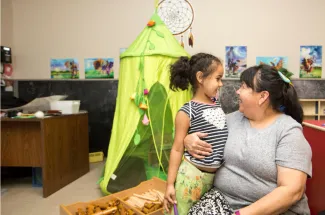
EECD partnered with the Nova Scotia Community College (NSCC), in collaboration with Mi’kmaw Kina’matnewey (MK), to develop and deliver a full-time online Mi’kmaw ECE diploma program for Mi’kmaw or other Indigenous individuals wanting to work in the ECE profession in Nova Scotia.
- Through Etuaptmumk (two-eyed seeing), the program blends online study and in-person learning with infants, toddlers, preschoolers and school-aged children.
- Introducing students to the unique perspectives of the Mi’kmaq, including concepts like Msit No’kmaq and Netukulimk.
- Applicants must identify as Mi’kmaw or Indigenous.
- Tuition, books, and student fees funded by EECD.
Pathways Program for Newcomers (Work and Learn ECE Diploma)

EECD partnered with the Immigrant Services Association of Nova Scotia (ISANS), the Nova Scotia Community College, and the Nova Scotia College of Early Childhood Education, to develop an ECE program that supports newcomers to enter the profession.
- Newcomers gain employment in a licensed child care or pre-primary program while earning their diploma through part-time online studies.
- Tuition, books, student fees, and language training funded by EECD.
- Program has previously been offered by NSCC and NSCECE.
Work and Learn ECE Diploma Program (Designated Counties)
EECD is fully funding the costs of tuition, textbooks, and other program fees for those recently hired as untrained educators and living, or planning to work in one of the following designated areas:

- Northern (Pictou, Antigonish and Guysborough Counties)
- South Shore (Lunenburg and Queens Counties)
- Western Cape Breton (Inverness, Victoria & Richmond Counties).
Residents of the above designated areas, with employment or guaranteed employment by October, will be prioritized for admission.
Applicants in other areas of the province will be added to a waitlist, and may be offered a seat only after the waitlist of applicants in hard-to-recruit areas is exhausted.
- Please visit the NSCC website for full admission requirements.
- For questions on eligibility to participate in the program, please contact: ecework.learn@nscc.ca
Getting a head start in High School
Students in eight high schools across Nova Scotia are piloting the High Skills Major (HSM) Certificate in Early Childhood Education (ECE).
Students will explore the ECE field through coursework, community-based learning, certifications, and portfolio development. They will be required to complete at least one Co-operative Education placement in a licensed child care centre or Pre-primary program.
The HSM in ECE supports learners in building clear pathways into post-secondary education and careers in the early childhood sector.
For more information visit: Nova Scotia High Skills Major Certificate

Orientation Training for Early Learning and Child Care
Individuals seeking the following Classification Levels:
- Entry Level
- School Age Approval
According to Regulation 37 of the Early Learning and Child Care Regulations, facility staff working directly with children must complete Orientation Training or post-secondary courses in early childhood education that are comparable to Orientation training, no later than 6 months after their employment date.
It is strongly recommended that staff register and begin the orientation immediately upon hire.
To be eligible to register for Orientation training, individuals must:
- Be a resident of Nova Scotia.
- Work in one of the following:
- regulated early learning and child care program,
- licensed child care facility,
- Pre-primary program,
- NS Before and After Program, or
- be a provider for a Family Home Day Care Agency;
- Have been pre-approved by Classification Services to receive School Age Approval; or Have been pre-approved by Classification Services as an internationally educated learner.
Access the modules anytime, from anywhere with internet. Complete sessions at your own pace (plan to spend between 25–50 hours on the modules).
Web site: elcconline.ednet.ns.ca
How to get an account
Before you can take a course, you must have a myNS Account. If you don't already have one, you will be asked to create your free account during the login process.
- Go to elcconline.ednet.ns.ca
- In the upper right corner of the page, click Log in. You will either be re-directed to myNS Account or, if already logged in, you will see a list of available courses.
- Select the course you want to enter.
- Click the Enrol me button. You should now be enroled in your course.